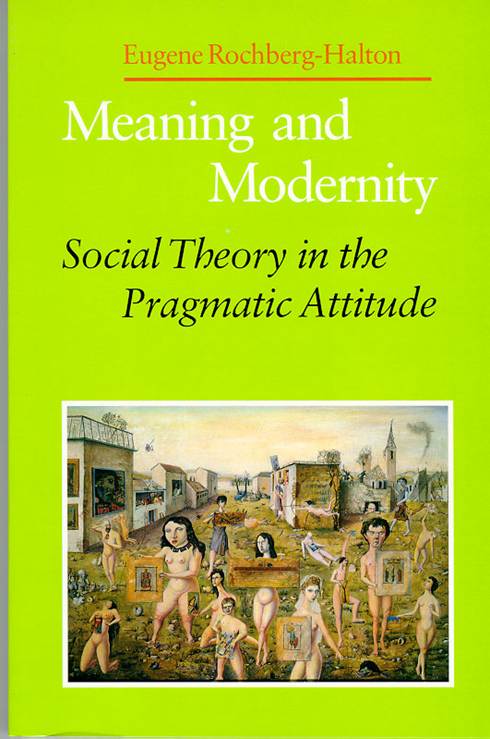
Meaning
and Modernity
Social Theory in the Pragmatic
Attitude
Eugene Rochberg-Halton [now
Halton]
University of Chicago Press, 1986
In a review in The Times Literary Supplement, Charles
Townshend wrote:
“Halton’s
answer to the dilemma of modernity is a still more striking synthesis, which he
labels ‘critical animism’ (as distinct from primitive animism).
Meaning and Modernity belies its conventional exterior: it is a passionate
tract against the 'diabolical tyranny of the rational'...He pits
his researches into the attitudes of Chicagoans to their household goods and to
their city against the abstract semioticians who have emptied signs of their
capacity to 'live objectively in the transactions people have with them'...Such
humanism will probably strike his fellow social theorists as downright weird,
but his work shows that the cracking shell of modernism will provide a rich
intellectual agenda.”
From the book cover:
The
twentieth-century obsession with meaning often fails to address the central
questions: Why are we here? Where are we going? In this radical critique of
modernity, Eugene (Rochberg-) Halton resurrects pragmatism, pushing it beyond
its traditional formulations to meet these questions head on.
Drawing
on the works of the early pragmatists such as John Dewey, George Herbert Mead,
and particularly C.S. Peirce, Meaning and Modernity is an ambitious attempt to
reconstruct concepts from philosophical pragmatism for contemporary social
theory. Through a vigorous and illuminating dialogue with other perspectives in
the social sciences, (Rochberg-) Halton reveals the value of the pragmatic
attitude as a mode of thought, one which speaks to the contemporary hunger for
significance in a world where rationalized technique has all too often severed
subject and object from their living context...
Throughout
the work is a sustained critique of modern culture in which (Rochberg-) Halton
brings his reconstruction of the pragmatic attitude to bear on
twentieth-century thought and its counterparts in the expressive arts. His
engaging analysis encompasses figures as diverse as Simmel, Freud,
Wittgenstein, Schoenberg, Adolph Loos, Mumford, Melville, the "Vienna
School of Fantastic Realism," and Doris Lessing.
The
author's semiotic approach to culture allows him to move freely and easily
across many disciplines, including anthropology, sociology, communications,
art, literature, and philosophy. This is a work of rare originality and power
that is sure to provoke discussion, for Rochberg-Halton creates new premises
for understanding the human web of meaning.
Table
of Contents
[with
some annotations and selected paragraphs]:
Preface
Part 1: Pragmatic
Roots
1. Inquiry and the
Pragmatic Attitude
The special genius of
pragmatism is the way it provides a broadened framework of reason as a process
of living, existentially rooted inquiry that includes our deepest biosocial
sentiments. Dialogue, or "conversation," is a central concept of pragmatism,
but the conversation is one ultimately rooted within a generalized conception
of nature: a conception in which nature itself is a biocosmic, emergent
dialogue.
2. Qualitative
Immediacy and the Communicative Act
"Qualitative
immediacy" (also termed "quality" in its philosophical sense and
"esthetic quality") is of fundamental importance within the pragmatic
conception of meaning as interpretive act, and yet it has been virtually ignored
by social scientists. The concept is traced through its foundations in Peirce's
philosophy, its development in Dewey's theory of esthetic experience, and its
relation to the general pragmatic conception of the self. The importance of the
"I" in Mead's view of the self is seen as similar to Firstness in
Peirce and esthetic experience in Dewey. Those turning to qualitative
approaches ought to consider qualitative immediacy as a genuine addition to our
understanding of human communication.
Part
2: Semiotic
3. Situation,
Structure, and the Context of Meaning
Two of the approaches at
the forefront of contemporary sociological interest in meaning, symbolic
interactionism and structuralism, share an interest in the role of signs and
symbols in social life, yet take radically different standpoints concerning the
nature of signs and the locus of meaning. Symbolic interactionists stress the
ongoing process of the "situation" as the determinant of meaning,
whereas structuralists claim that meaning must be sought at the deeper level of
"system" or "structure" rather than at the surface. By
comparing some foundational concepts underlying these traditions, such as the
nature of the sign in Peirce and Saussure and Durkheim and Mead, and then
exploring recent developments in structuralism and symbolic interactionism, a
critical appraisal of their theories of meaning is made in the context of an
emerging semiotic sociology.
4. The Foundations of
Modern Semiotic: Charles Peirce and Charles Morris (with Kevin McMurtrey)
The contemporary use of
the term "semiotic" derives from the theory articulated by Charles
Morris, who in turn acquired it from C. S. Peirce, the founder of modern
semiotic. Peirce's semiotic is based upon his criticism of Cartesian nominalism
with its emphasis on individual intuition as the basis for knowledge. Peirce
argued for semiosis or triadic mediation as the sole source and end of
cognition, as opposed to unmediated knowledge. Morris attempted to synthesize
pragmatism with logical positivism to produce a new "science of
science" to be termed semiotic. The result of Morris's attempted synthesis
was a philosophy that combined the basic assumptions of logical positivism with
a deceptive admixture of Peirce's semiotic vocabulary, and systematically
reintroduced the very Cartesian intuitionism to which Peirce's semiotic is
opposed.
5. The Fetishism of
Signs
“Contemporary semiotics, on the whole…tells us much more
about the advanced culture of Abstractionism, or uprooted rationality, than
about the nature and purpose of signs…A transformation is needed from our
Age of Abstractionism, with its fetishism of signs, to an animism of signs in
which the imagination and the signs it gives birth to will not only reconnect
us with our biocultural heritage but also animate us to cultivate living
purpose, not merely inert code. A healthy culture is not one in which instinct
and reason are irreconcilably opposed, as the nature-versus-culture
dichotomists hold, but one in which natural inclinations could find expression
in and act upon the process of discursive reason. Culture is far more than the
signification of rational codes and communication of ‘information.’
And semiotics is far more than the conspicuous display of the unintelligible in
the name of the obscure. Semiotics must become the living attempt to render
meaning clear, to make its language as supple a one as we can fashion and its
ultimate object that mysterious, encompassing sign-web that is not only greater
than human rationality but that animates the very nature of things” (p.
95, 105).
Part 3: A Pragmatic
Theory of Culture
6. Culture Considered as Cultivation
“To say
that culture lives is anathema to
most contemporary social theory. The concept of culture is viewed in most
quarters today as an abstract system…a meaning-system that arbitrarily or
conventionally provides the values and beliefs that orient a
society…Culture…is something much more than…the limited
conceptual views of modern rationalisms, and in fact forms a critique of their
narrowly prescribed limits of reason. In the view proposed here, reason is
capable of real and living growth, and nature is capable of critical
intelligence. It is in this sense that I will consider culture as cultivation” (pp 109, 110).
“…artifacts
can serve as a medium for socialization and self-expression, and hence
transactions with one’s cherished possessions, either actually or
symbolically, can be seen as sign expressions of the self. The person, as a
complex of living, feeling, sign-habits, extends into and derives from the
spatiotemporal environment through signs” (p. 137).
Part 4: Meaning,
Materialism, Metropolis, and Modernism
7. Object Relations,
Role Models, and Cultivation
“Even
before the infant is born its parents have begun to project an environment of
clothing, toys, and furnishings that will begin the socialization process. The
self arises in a milieu that is constantly ‘addressing’ it, telling
it who it is through its surroundings, telling it how to become he or she.
Transactions with one’s cherished possessions, either actually or
symbolically, can thus be seen as sign-expressions of the self. The person, as
a complex of living, feeling, sign-habits, does not stop with his or her
physical organism but quite literally is in continuous transaction with the
broader spatiotemporal environment through signs” (p. 167).
8. Remembrance of Things Present
“Perhaps animism is not as primitive and
obsolete a belief as the modern consciousness has claimed, once we realize that
one’s relationship to valued surroundings is an animism of signs. The portrait is a family icon, a veritable
ancestor totem, which lives in the remembrance of the generations who receive
and come to cherish it, and in turn transmit it to their descendants. Hence
when the mother says, ‘It’s part of the continuity of who I am,
where I come from, where I’m going,’ she is correct not only figuratively,
but ontologically as well. The portrait forms an essential element of those
habits of conduct in which her self consists: it is a
direct physical link with preceding family members, with her individual sense
of identity, with what she will become individually, and what her family will
become collectively. It is both a socializing sign and sign-expression of her self, just as other feelings, experiences, memories,
and thoughts that shape her self are” (p. 171).
“In this sense the view I am
proposing might be termed critical
animism. Animism has traditionally referred to the belief that certain
animals, plants, or inanimate things such as ritual objects, are actually
spirits, and as such should be treated as autonomous personalities. Animism is
a view rather antithetical to anyone brought up in the modern Western tradition
who believes that thought and things are radically different substances. Now I
am not suggesting that we should believe in fairies and leprechauns, but what I
am proposing is that objects are not merely inert matter but are living signs
whose meanings are realized in the transactions we have with them and that need
to be critically cultivated in the context of the consciousness they bring
about. This critical animism of signs means that all three elements of the
transaction—person, thing, and what the thing represents—are
intrinsically involved in its meaning. In other words, against the idea that
meaning is a disembodied conceptual entity located in a brain, cultural system,
or ‘deep structure,’ it is more accurate to view meaning as
including the sign-objects through which representation occurs” (p. 185).
9. The City as Living Memory
“The metropolitan
environment, from this semiotic perspective, is a living sign-practice
transcending the present moment and objectively situated in the minds and
hearts of its inhabitants as well as forming an external dimension of their
minds and hearts. The city is itself a public possession, but one which should
also simultaneously possess its inhabitants by endowing them with the energy,
communicative forms, and opportunities for participating in the larger drama of
urban life” (p. 191).
10. Money is No
Object
“Money is surely one of the purest means yet invented, paradoxically commanding its votaries to see it
as purest goal. Yet money can and
does act as means, and the materialist and nominalist fallacy lies in mistaking
the nature of the acquisition of selfhood. In seeing character as thing purchased, externally, rather than
practice cultivated, the modern
consumer-self stands as persona of self-estrangement, as negation of the
inherent qualities of life’s activities. Selfhood is not a product purchased,
it is a gift and a craft and an inheritance. It is the unique nature we are
given and determined to develop through all of life’s activities, and
whose ultimate purpose is to give itself back to the community” (p. 221).
11. Reality,
Community, and the Critique of Modernism
This chapter develops a
critique of modern culture as rooted in the faulty and unsustainable premises
of cultural nominalism. A wide-ranging discussion using diverse sources,
including Moby Dick, Wittgenstein’s Vienna, and contemporary arts is brought
to bear on the question of what a sustainable civilization might involve.
Epilogue
“A social theory
that limits itself to ‘mere rules’—whether those of a code or
even those of a ‘theory of communicative action’—and in so
doing does not include the central fact of a living human purpose that will
never be encapsulated or harpooned by the standards of abstract rationality, is
not likely to meet the needs of the emerging cultural mind. Similarly a theory
that denies ‘ideas of the immortal, ceaselessly prolific kind,’
whose being it is our task to imagine and actualize, and which in turn endow us
with far greater possibilities for animated development than mere abstract
rationality could ever do, ignores, in my opinion, the most pressing need of
our time—to break out of the hubris of abstraction, to reconnect our
critical capacities of rationality with our admittedly repressed or dormant,
but in the end far more mature, capacities for ‘critical’ sentiment
and perception. More than ever, in our modern hubris, have we closed ourselves
up through our ‘mind forg’d manacles.’ More than ever must
‘the doors of perception’ be cleansed through a critical animism
that acknowledges the true social continuity of being, the relative immaturity
and great capacity to err of our rational ego, the tempered maturity of the
human capacity to marvel and to imagine—a critical animism that can
transform those imaginings into humanized, cosmically rooted practices”
(p 276).
Cover art: Fritz Janschka, Wohin gehst Du? (Where are you
going?), 1947