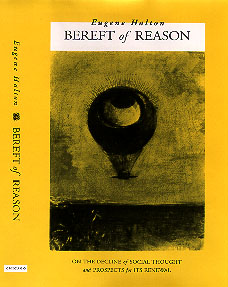

Photo by David Pace
Bereft of
Reason:
On the
Decline of Social Thought and Prospects for its Renewal
by Eugene Halton
Published by The University of Chicago Press, 1995,
paper, 1997
Comments on
Bereft of Reason:
"This is an
original, incisive, and badly needed book. In prose as vigorous as his
argument, Halton addresses issues urgent in many
disciplines, as well as in our common culture."
--Robert N. Bellah,
University of California, Berkeley
"Without wishing
to descend into hyperbole, I cannot recommend this book any more strongly.
Halton has accomplished a tour de force...His passionate, articulate
prose is a welcome antidote to the scientistic, jargon-ridden norm. The
physical qualities of the book, its binding, typesetting, and overall design,
match in quality its intellectual content. Bereft of Reason deserves the
widest readership: there has been no stronger or more telling critique since
[C. Wright Mills's] The Sociological Imagination." --Michael
Keaney, Cultural Dynamics
"[Halton] takes
the 'ghost in the machine' as a dominant defining metaphor for modern thought
and life, and criticizes it with gusto, wit, wide reading, and philosophical
acumen." --Robert J. Mulvaney, Review of Metaphysics
"Bereft of Reason is a thoughtful critique informed by a passionate
commitment to the renewal of critical concerns. For this reason alone it should be widely read and inform current
debates." --Lauren Langman, Sociological Inquiry
"Halton's energetic
and insistent pursuit of several important themes regarding contemporary social
life and the theories which try to account for it make this a rare and
fascinating book." --Alan Sica, Pennsylvania State University
"My positive
responses were largely to the criticisms of contemporary social and
sociological theory, my negative ones to the harangues against the modern
condition.... The ups and downs of my reaction to the book ended with the final
chapter, in which admiring assent displaced even strong approval. When Halton
writes that 'rational maturity means living in the gap between rational
comprehension and the sense of things which never gets completely
comprehended' (his emphasis) I can only marvel at the sheer rightness of the
statement." --Dennis Wrong, Contemporary Sociology
"Halton
undertakes to challenge numerous assumptions common to both defenders of
modernity and its postmodern critics as well as to set a new direction for
social theory. Its extensive critical commentary is directed not only to much of the contemporary philosophical scene, but in general to
the broader intellectual ethos of our times, including various currents within
the arts and social sciences.
The
principal object of Halton's critique is something that he terms 'cultural
nominalism,' a view which he asserts is pervasive throughout modern culture and
which entangles much of our thought within dubious and outworn dichotomies.
What is urgently needed, he proposes, is the abandonment of these and other
standard dichotomies of modern thought and the formulation of a pragmatic,
nonfoundationalist conception of reasonableness.
Halton
argues that virtually all of modern social thought has its roots within a
falsely dichotomous worldview, and that providing for its renewal requires
nothing less than 'a more fundamental questioning of the entrenched premises of
the modern era itself.'
Social
theory, Halton argues, must remain mindful of the manner in which culture and
the self remain continuous with natural processes, as well as the manner in
which reason itself remains irrevocably tied to sentiment, imagination, and
organic life. Reason must retain a broader connotation than mere 'rationality'
understood along positivistic, utilitarian, or even critical theoretic lines.
It is a human capacity intimately associated with the passions and with mythic
and metaphorical modes of comprehension. A proper account of social reason
includes forms of reasonableness reminiscent both of organic philosophy and of
the pragmatic tradition." Paul Fairfield, Philosophical Books, 1997
"This bold,
important book challenges the fundamental assumptions of current social theory,
identifies the vital contributions of recent thinkers who have been consigned
to 'intellectual oblivion,' and indicates promising prospects for the renewal of
thought and culture. It merits serious attention and invites response."
--Frank G. Novak, Jr. Clio: A Journal of Literature, History, and the
Philosophy of History
About the book:
In this radical
critique of contemporary social thought, Eugene Halton argues that both
modernism and postmodernism are damaged philosophies whose acceptance of the
myths of the culture/nature dichotomy make them incapable of solving our social
dilemmas.
The
recent vogue of social theory for the social sciences, literary and cultural
studies, and philosophy, has brought with it the promise of breaking down
unnecessary boundaries and overturning stale canons. Yet Halton claims that the
dominant ideas today tend toward emaciated theories of meaning, viewing human
conduct as consisting of talking heads, reading heads, of spectatorial heads
reduced either to enacting a convention or acting out "differences"
from conventions. Far from being able to confront the self-destroying
calamities of our time, they form an intellectual opiate. From defenders of the
modern project, such as Juergen Habermas, to postmodern critics such as Richard
Rorty, Stanley Fish, Jean-Francois Lyotard, or James Clifford, there is all too
often an uncritical acceptance of the nominalist premises of "the ghost in
the machine."
Bereft
of Reason argues that the leading
social theories of our time remain shackled to the modern myth of "the
ghost in the machine." In Halton's view most contemporary attempts to
provide better theories of rationality or alternative theories of antirationality
assume the dichotomy of a spectral view of reason and mechanical view of
materiality which underlies the modern era, and, in his words, "the modern
error."
In
chapters ranging from the codification of social thought to the concept of
life, the cultic roots of culture, and so-called "neopragmatism,"
Halton claims that contemporary thought has lost touch with the bio-semeiotic
sources of reasonableness. Some neglected paths in twentieth-century social
thought and philosophy of the past century, particularly the work of Lewis
Mumford and Charles Peirce--as well as someone very much in the contemporary
picture, Vaclav Havel--together suggest an outline for a new and non-modern
basis for contemporary thought.
In
the author's view a more fundamental questioning of the entrenched premises of
the modern era itself is urgently needed, which requires critically delving
into the deeper sources of reasonableness, which modern thought has tended to
deny or degrade. Modern culture reified physicality while etherealizing the
perfusion of signs in which we humans live and by which we evolved into
humankind: signs which bodied us forth from an organic nature which is far more
mysterious than a mere machine, no matter how complex a machine nature is
conceived to be.
The
human person is far more than simply a form of knowledge, social construction,
or contingent difference in Halton's perspective, ultimately the self is an
organic social being infused with the spontaneous passions of life, capable of
feeling, experiencing, and empathically responding to the communicative
environment, as well as rationally judging him or herself and the world,
rightly and wrongly.
Bereft
of Reason is a passionate plea for a
fundamental reexamination of the entrenched assumptions of the modern era.
Dealing with issues of vital concern to modern societies, it should appeal to
readers across a number of disciplines.
Chapters: (with brief selections)
1. The Codification of Social Theory
3. The Cultic Roots of Culture
4. Lewis Mumford's Organic Worldview
5. The Transilluminated Vision of Charles Peirce
6. Juergen Habermas's Theory of Communicative Etherealization
7. The Neopragmatic Acquiescence: Between Habermas and Rorty
8.The Modern Error and the Renewal of Social Thought
-----------------------------------------------------------------------------------
Return to Eugene
Halton's Homepage