Introduction

We are a theoretical group interested in the collective behavior of physical and biological systems in which disorder and strong interactions play an important role. We specialize in statistical mechanics, soft condensed matter, evolutionary biology and ecology.
We are particularly interested in questions surrounding the arrow of time, such as how materials and organisms fall apart, how evolution tangles ecological relationships, how our memory of the past fades, and how predicting the future relates to retrodicting the past. Below is a brief description of some of our recent work.
Aging, Failure and Death
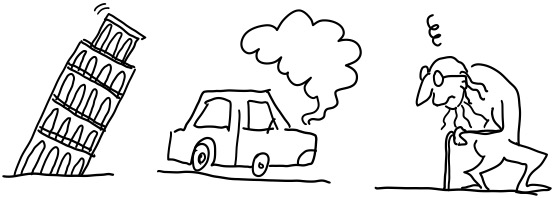
Standard theories of aging typically focus on microscopic mechanisms such as oxidative damage or telomere shortening. However, we age and die not because we run out of cells, but because small-scale failures at the cellular level manifest at larger scales, leading to a macroscopic catastrophe.
We view aging as an emergent universal property of systems that consist of a large number of interdependent components (read). The video below shows how a large number of interdependent nodes fail.

Failure can also be viewed as a microscope that reveals the structure of a complex system. The failure times of components inform us how they are interconnected.Read.
Recently, our experimental collaborators verified the interaction-based picture of aging in synthetic tissues. Read.
Based on experimental observations and earlier theoretical ideas, we predict that tissues collapse through a wave of failure that propagates from outside inward, with non-monotonic velocity. Read.
We organized a niceworkshop
Disordered Materials
Materials such as glasses, polymers, disordered crystals, quasicrystals and proteins lack long-range order, and are thus referred to as disordered solids. The standard model describing disordered solids at low temperatures postulates that these materials are composed of two-level systems: atoms, or groups of atoms, with two available discrete configurations.
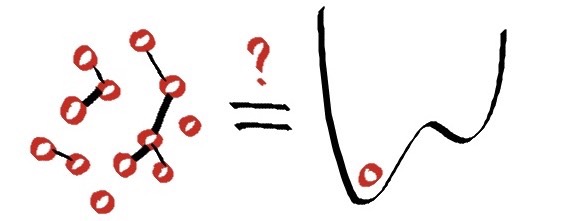
All disordered solids universally exhibit certain properties that cannot be explained by the two-level-systems model. Here is a critique of the model, and here is a more general model from which the universality is derived.
Evolution of Cooperation


We develop physical models of evolutionary game theory to understand how cooperation emerges and persists despite the evolutionary incentive to cheat. Recently, we discovered that flow shear enables and promotes social behavior in microbes. Specifically, shear tears apart social community clusters, thereby limiting the spread of cheating strains. The videos above show how flow patterns can shape social evolution. In a vortex, cooperative microbes can persist only within an annular region. In a flowing pipe, they can persist only near the boundaries, where the shear is larger than a critical value. Everywhere else, cheaters take over, causing the groups to weaken and die. Read.
We also found that physical characteristics such as diffusion lengths, flow patterns and molecular decay rates play a significant role in determining whether a microbial community evolves specialized or generalist forms of cooperation.Read.
Although cheating behavior is often devastating for social species, we have discovered that, in special cases, cheating can counterintuitively benefit the community. This can happen in a disease or tumor where rapid growth is beneficial. Cheaters fueled by altruists will expand rapidly and overwhelm the host immune system. Read.
Rewinding Randomness

Many astonishing facts about the origin of the universe, evolution of life or history of civilizations will never be directly observed, but will only be inferred in light of their manifestations in the present. Forward in time, any state of knowledge, regardless of how exact, will invariably deteriorate into an entropy-maximizing probability distribution. We address the converse question: Given a measurement at the present time, how rapidly does our knowledge fade away backward in time? Read.
Theoretically relevant information such as original causes or underlying mechanisms is seldom directly observable. For example, one can measure the amount of proteins expressed in a cell but not necessarily know what interactions led to that expression pattern. One can observe a species decline in number, but not know exactly which ecological relationship or triggering event caused the decline. When a virus spreads seemingly spontaneously, or when an invasive species expands its range, it is very difficult to know exactly where it came from or which evolutionary trajectory led to its final success.
We develop algorithms and formulas to infer causal origins from raw empirical data, such as identifying the original triggering event given an observed final state.Read.
Entropic Forces

When two macromolecules come very near each other in a fluid, the surrounding fluid molecules, having finite volume, are less likely to get between them. This causes the macromolecules to approach each other as if attracted. This entropic force is called depletion. Here we calculate the depletion force between linear disordered macromolecules.Read.
Slow Demons
A Maxwell's demon is a hypothetical device that opens and closes a gate separating two chambers filled with gas, based on its observations of approaching gas molecules. In this way, it sorts the atoms and reduces the entropy of the system. This thought experiment has been instrumental in establishing the connections between information, computation and thermodynamics for over a century.
Here we take into consideration the finite response time and finite size of the demon. For example, the gate cannot operate faster than the speed of light. These limitations establish theoretical upper limits to heat and mass transfer via local information processing.Read.
Ecological Evolution
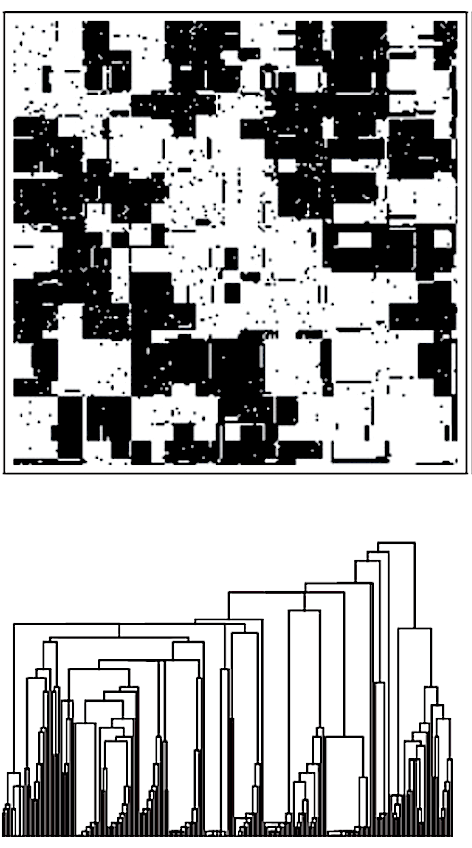
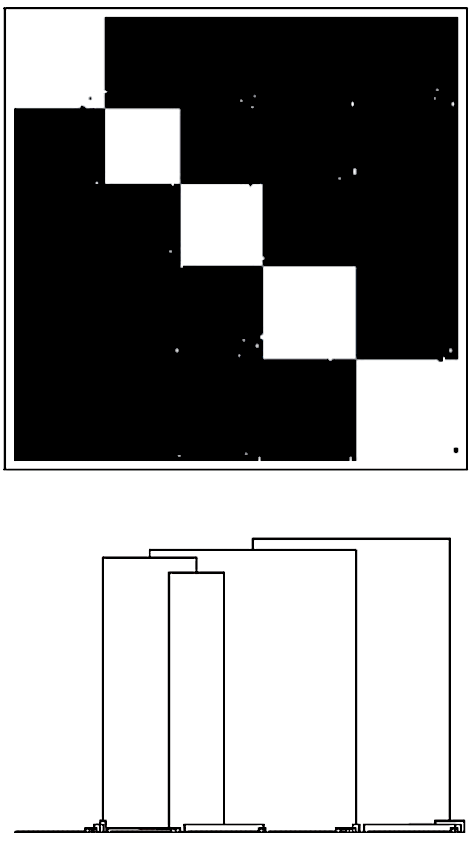
Start with a large number of unrelated species, put them together and wait for many generations. Eventually, the interactions between them evolve into a tangled web of exchanges—so much so that no species can survive in isolation. Above are connectivity matrices and phylogenetic trees of two such communities subject to different selective pressures. Higher pressures (right) lead to the formation of specialized communities. Read.
Model Awareness
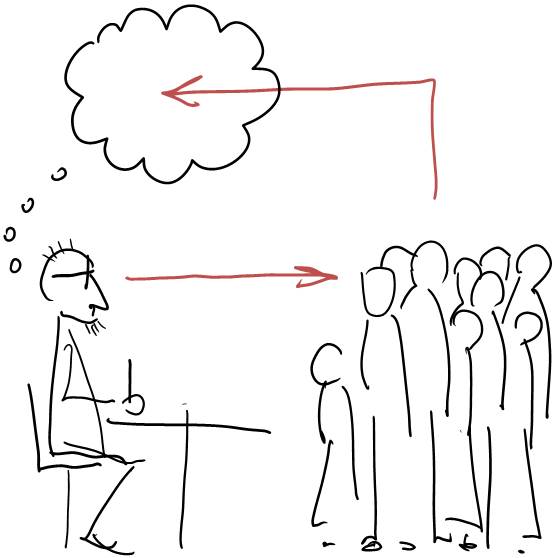
A model need not be a passive descriptor of its subject. If the subject is affected by the model-building process, the model must be updated in real time. In some cases, the very act of model building can cause an otherwise correct model to fail, or cause an otherwise incorrect model to succeed. In other cases, attempting to predict the future can be detrimental to the predictor.Read.


We studied the dynamics of a predictive swarm aiming to maximize the uptake of some resource. A predictive agent tries to estimate what others will do and updates its behavior accordingly. All other predictive agents are doing the same, trying to predict the trajectory of agents that are trying to predict them! The videos above show a few iterations of a predictor's thoughts while it says, “They know that I know that they know that I know...” On the left, resources are initialized randomly, whereas on the right they are concentrated in two spots, one large and one small. Read.
Active Inference
Scientific inference involves obtaining the unknown properties or behavior of a system in light of what is known, typically without changing the system. We propose an alternative: a system can be modified in a targeted way, preferably by a small amount, so that it becomes more predictable or more retrodictable. Read.
Quantization of Temperature
Temperature is conventionally defined in terms of the number of “possible” microstates, given a set of macroscopic constraints such as total energy or particle number. It is remarkable that an information-theoretic quantity can connect so well to physical observables, such as the height of a mercury column or the volume of a balloon.
Here we offer an alternative view of temperature and propose that temperature must be reformulated as a nonlocal, non-realistic quantum variable. We demonstrate that if a large but finite system is split into two subsystems, their temperatures must become entangled. Thus, an operator description of temperature becomes necessary to avoid an EPR-type causality violation. In this picture, temperature is subject to the constraints of quantum mechanics, where its measurement must necessarily accompany a wavefunction collapse into a “temperature eigenstate.”Read.